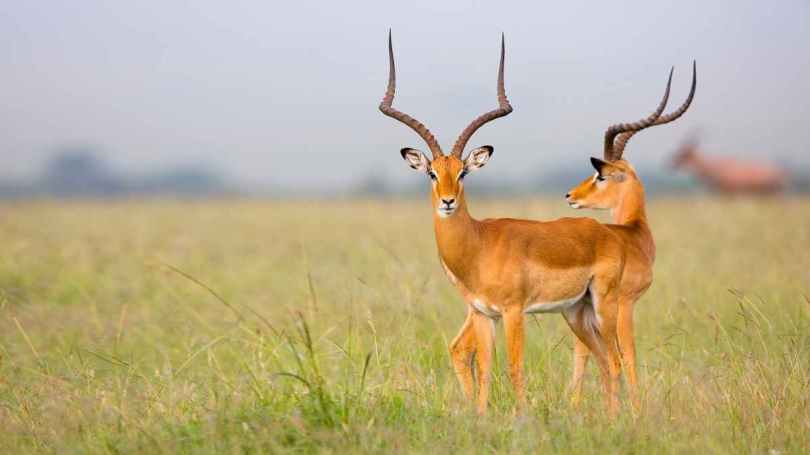
The name blesbok originates from the Afrikaans word for “white blaze,” a distinctive feature found on this medium-sized animal’s muzzle. Their body color ranges from light to dark brown. Both males and females have heavily ringed horns, though the females’ horns are more slender. Males are also slightly heavier in body mass.
Blesbok were once among the most abundant species roaming the grasslands of South Africa’s interior plateau. Unfortunately, they were heavily hunted by pioneers for their meat and hides, becoming alarmingly scarce by the late 1800s. However, thanks to sound conservation policies and the rise of game farming, their numbers have rebounded dramatically, and the blesbok is no longer on the brink of extinction.
Historical Distribution
Blesbok (Damaliscus pygargus phillipsi) are endemic to South Africa. Historically, they were found across the high-lying central grassland plateau known as the Highveld.
The majority of the population occurred in the Free State province and the elevated regions of Gauteng, Mpumalanga, extending as far as northern KwaZulu-Natal.
Where to Hunt Blesbok
Blesbok are predominantly hunted in the Highveld regions of South Africa. Over time, they have been introduced to areas far beyond their original range and can now be hunted in all provinces of South Africa, as well as in Namibia. They’ve even adapted to environments such as the Bushveld and semi-arid desert regions. While not their natural habitat, with proper management—including open grassland, water sources, and mineral supplements—they can thrive.
However, they are unable to survive in densely wooded areas like the Lowveld and the Kruger National Park. In such terrain they are highly vulnerable to predation. Blesbok are the natural prey of cheetahs, leopards, caracals, and hyenas. Jackals typically target young blesbok, though like many antelope species, the calves can run almost as fast as the adults within just a few hours of birth.
How to Hunt Blesbok
As a diurnal grassland species, blesbok are best hunted while grazing during the early mornings and late afternoons. Even though they rest during the heat of the day, they remain visible on open grasslands and can be hunted throughout daylight hours.
During the rut, males aggressively defend their territories, and in many cases, this behavior persists throughout the year. Solitary territorial males may be encountered outside of the breeding season as well, though judging horn length can be tricky when you’re looking at a lone animal rather than comparing individuals within a herd.
When searching for blesbok, keep in mind that they favor short grass and are particularly drawn to fresh, green shoots—especially on recently burnt areas and along firebreaks.
Rifle Hunting
Blesbok are typically hunted using the “spot and stalk” method. As inhabitants of open grasslands, which offer limited cover, the greatest challenge is often the final approach. Being short grass grazers makes it even tougher—there’s little to no concealment.
Unlike woodland species that use trees and brush for protection, blesbok rely on distance. More often than not, their comfort zone is well beyond the average hunter’s shooting range.
These hunts often require a well-planned stalk and, depending on the hunter’s ability, may even involve crawling. Shots tend to be longer—often around 300 yards—and can be especially tricky on a windy day out in the open.
Another method involves setting up in a known blesbok hotspot and waiting in ambush. In many cases, a tracker will drive the herd toward the hunter’s position. With the animals focused on the tracker, the hunter may have the opportunity for a clear shot.
While this method might sound easier in theory, it’s far from simple. In areas where blesbok have been frequently hunted, they can become extremely wary and elusive, even if their escape routes are known.
Hunters who have culled blesbok at night using a spotlight will also know that, unlike most antelope, these animals do not freeze when caught in the beam—they keep moving, making a clean shot even more challenging.
Bow Hunting
Stalking a blesbok with a bow is incredibly challenging and suited only to highly skilled bowhunters—ideally dressed in a ghillie suit to blend into the open terrain.
Most blesbok taken by bow are hunted from a blind. As a water-dependent species, they need to drink regularly and are often drawn to waterholes enhanced with mineral licks and supplementary feed.
More Blesbok Hunting Tips
On some properties, blesbok are found in large herds numbering over 100 animals. As mentioned earlier, stalking them can be difficult—but even once you’re in shooting range, a few more challenges remain.
First, accurately estimating distance over flat, open terrain can be tricky. Using a rangefinder often requires the hunter to expose themselves, which can compromise the stalk. Tall grass between you and your target only adds to the challenge.
This is where flat-shooting rifles, such as a .270, come into their own. The flatter trajectory allows for a small margin of error in range estimation without significantly affecting accuracy.
Once in position, it can be hard for a professional hunter or guide to confirm the correct animal due to a lack of distinct landmarks and the constant movement of the herd. Blesbok often bob their heads—partly due to irritation from nasal bots—and are constantly milling about. During the rut, this is compounded by territorial males chasing rivals through and around the herd, further complicating shot placement.
Best Season to Hunt Blesbok
In South Africa, blesbok can be hunted year-round on registered game ranches that hold an exemption permit. In Namibia, they are legally hunted during the trophy season, which runs from 1 February to 30 November.
In KwaZulu-Natal, blesbok may be hunted year-round without any permits—only the landowner’s permission is required.
Trophy Quality
A solid benchmark for a trophy blesbok is a horn length of 14 inches. The current world record blesbok measures an impressive 20 5/8 inches.
Qualifying Measurements
The qualifying measurements for the record books are:
Blesbok
Safari Club International Record Book
Rowland Ward Record Book
Archery Min.
Rifle Min.
Record
Measuring Method
Minimum
Record
Measuring Method
35”
39″
56 3/8″
1
16 1/2″
20 5/8″
7-a
White Blesbok (Only recognised by SCI)
Safari Club International Record Book
Rowland Ward Record Book
Archery Min.
Rifle Min.
Record
Measuring Method
Minimum
Record
Measuring Method
52 3/8”
1
Breeding Projects
White blesbok have been around for some time and are officially recognized by Safari Club International in their record book. Through selective breeding focusing on recessive genes, a range of new color variants has emerged. However, the anticipated demand from trophy hunters has not fully materialized. As a result, the market value of these color variants continues to decline—both in terms of live animal sales and as trophy animals.
Some of the color variants now available for hunting include yellow (golden) blesbok, copper blesbok, and painted blesbok.
There is growing concern among scientists and ecologists regarding the level of interbreeding between blesbok and bontebok. Historically, the natural ranges of these two closely related species did not overlap. Today, the number of purebred individuals of each species is alarmingly low.
What Are the Main Differences Between Blesbok and Bontebok?
These two species are extremely closely related, even down to their taxonomic names. Generally, blesbok tend to be browner, while bontebok display a coloration that ranges from brown to a steely grey. However, in some regions, their color patterns may appear quite similar.
The most noticeable difference lies in the rump: bontebok have a clearly visible white rump patch, whereas blesbok do not. Additionally, bontebok typically have white lower legs, while blesbok rarely show continuous white markings in that area. Horn coloration also differs—bontebok usually have dark to black horns, in contrast to the lighter-colored horns of blesbok.
Fences
A standard cattle fence is usually sufficient to contain blesbok. They are not jumpers by nature, but if the bottom strand of the fence is high enough, they may creep underneath it.
Threats
Blesbok are a thriving species, and only two major concerns affect their long-term wellbeing: genetic contamination through interbreeding with bontebok, and occasional conflict with livestock farmers.
Many blesbok host a nasal bot—a parasite that, while not deadly, can negatively impact the health of domestic sheep and goats. Treating these parasites incurs additional costs for farmers. Another concern is a specific species of fly that lays its larvae in the eyes of blesbok. While this causes no harm to the blesbok, if the same larvae are deposited in the eyes of cattle or sheep, it can lead to blindness if untreated.
Although both the nasal bot and the fly are naturally occurring parasites, blesbok are often blamed for harboring and spreading these issues, which can create tension between game and livestock farmers.
Venison
Blesbok are among the top three most hunted species in South Africa, prized for their affordability, abundance, and excellent value for money. They are extensively bred by game farmers and are even found on traditional livestock farms protected by nothing more than basic cattle fencing.
Their meat is highly sought after by local hunters. Thanks to their moderate size, a blesbok carcass is easy to handle and process, especially when compared to larger antelope species.
___
Impala Hunting in Southern and Eastern Africa
Impala are Africa’s most commonly hunted antelope and often a hunter’s first kill. This rufous-fawn coloured, medium sized antelope remains one of the most graceful and beautiful on the continent. Impala is often referred to as the McDonald’s of the African Bushveld, because it is the most commonly killed prey animal for every predator from large eagles and pythons to humans, and also due to a conspicuous black ‘M” shaped mark on their backside. An interesting bit of trivia is that Impala is among the few species of African antelopes to have a car named after it: the Chevrolet Impala. Read more.
Hunting as a Wildlife Management Tool. By Cleve Cheney
There are very few natural habitats left in the world big enough to allow nature to regulate wildlife populations without any intervention from man. Even South Africa’s biggest national parks are too small to allow for this to happen. Smaller parks and private conservation areas may also not be afforded the luxury of a laissez-faire (“hands off – let nature take its course”) management approach. The main reason for this is that most conservation areas are fenced, or lie adjacent to, or are surrounded by areas of human development, and the wildlife within these areas are limited with regard to movement. Read more
African Trophy Fees: The Past Century
In 1904, two enterprising Australians, Victor Newland and Leslie Tarlton, started the first safari outfitting company operating in Africa. Along with Claude Tritton, their partner, they opened an office above the site of the famous Rowland Ward taxidermy studio in Piccadilly, London. These well-organised luxury safaris even offered champagne and caviar, imported at great cost and transported by mules, horses and oxen along with a stream of porters. In its time referred to as the safari capital, they operated out of the famous Norfolk Hotel in Nairobi (Kenya), known as Mile 326 back in the 1900’s. Read more